Applied AI engineering · LLM systems · coding agents

I build the systems around the model.

The model is the easy part. I work on everything around it: the tools it can reach, the state it reads, the context it gets, and how you would know any of it worked. I build in public and publish what actually runs.

Selected work GitHub

Tenzy taking a mirror photograph in an elevator, holding his phone
GitHub X YouTube LinkedIn

What I
work on

Focus

Areas I actually spend time in. Building, breaking, and reading about. Some of it is work, some of it is study. None of it is a rating.

Most of my time goes here. What an agent can see, what it is allowed to touch, and how much of the loop stays under a person's control.

  1. 01Tool surfaces
  2. 02Harness structure
  3. 03Authority boundaries

Deciding whether a change actually helped. I am more interested in a test that fails honestly than a number that looks good.

  1. 01Task sets
  2. 02Failure analysis
  3. 03Regression checks

The plumbing around a model call: how context gets assembled, where state lives, what happens on retry, and the places where a system quietly goes stale.

  1. 01Context engineering
  2. 02State and freshness
  3. 03Failure modes

Running models on my own hardware, to understand cost, latency, and what breaks when nothing is hosted for you.

  1. 01Local inference
  2. 02Quantization
  3. 03Hardware limits

Currently learning: how a model is shaped after pretraining, and how that shows up later as behaviour you have to design around.

  1. 01Fine-tuning
  2. 02Preference methods
  3. 03Model behaviour

Selected
work

Work

Two projects. One is live and working, one is still being built. Nothing here is filler, and nothing unfinished is dressed up as finished.

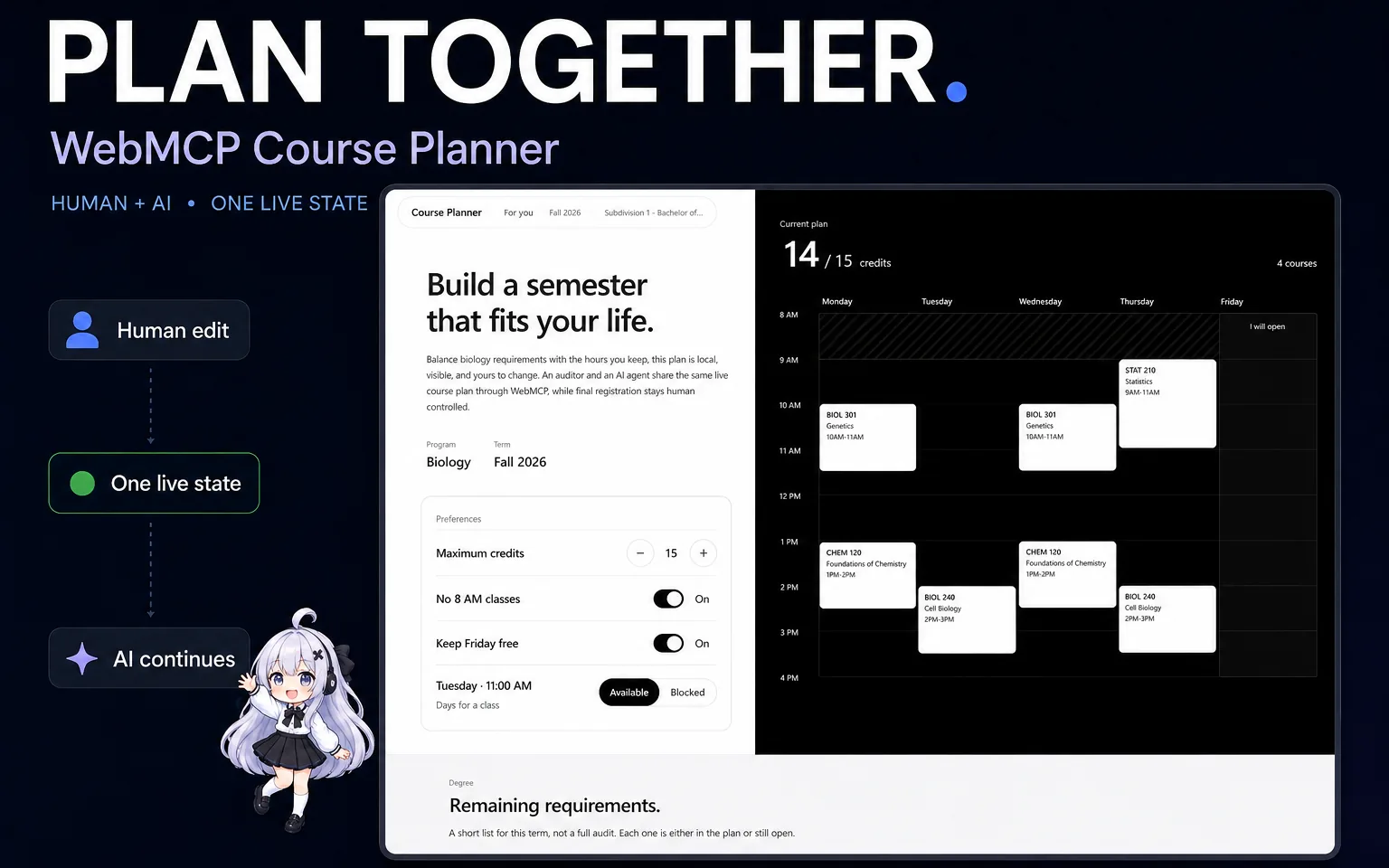
A fictional university Biology course planner where a person and an AI agent act on the same live application state through WebMCP tools. The agent reads the plan and can replace the selected courses, but it cannot touch the scheduling preferences the human owns. Change the page yourself and the agent's next read sees that newer state, not a stale snapshot.

get_course_planread current state set_course_planbounded course replacement
02 In progress

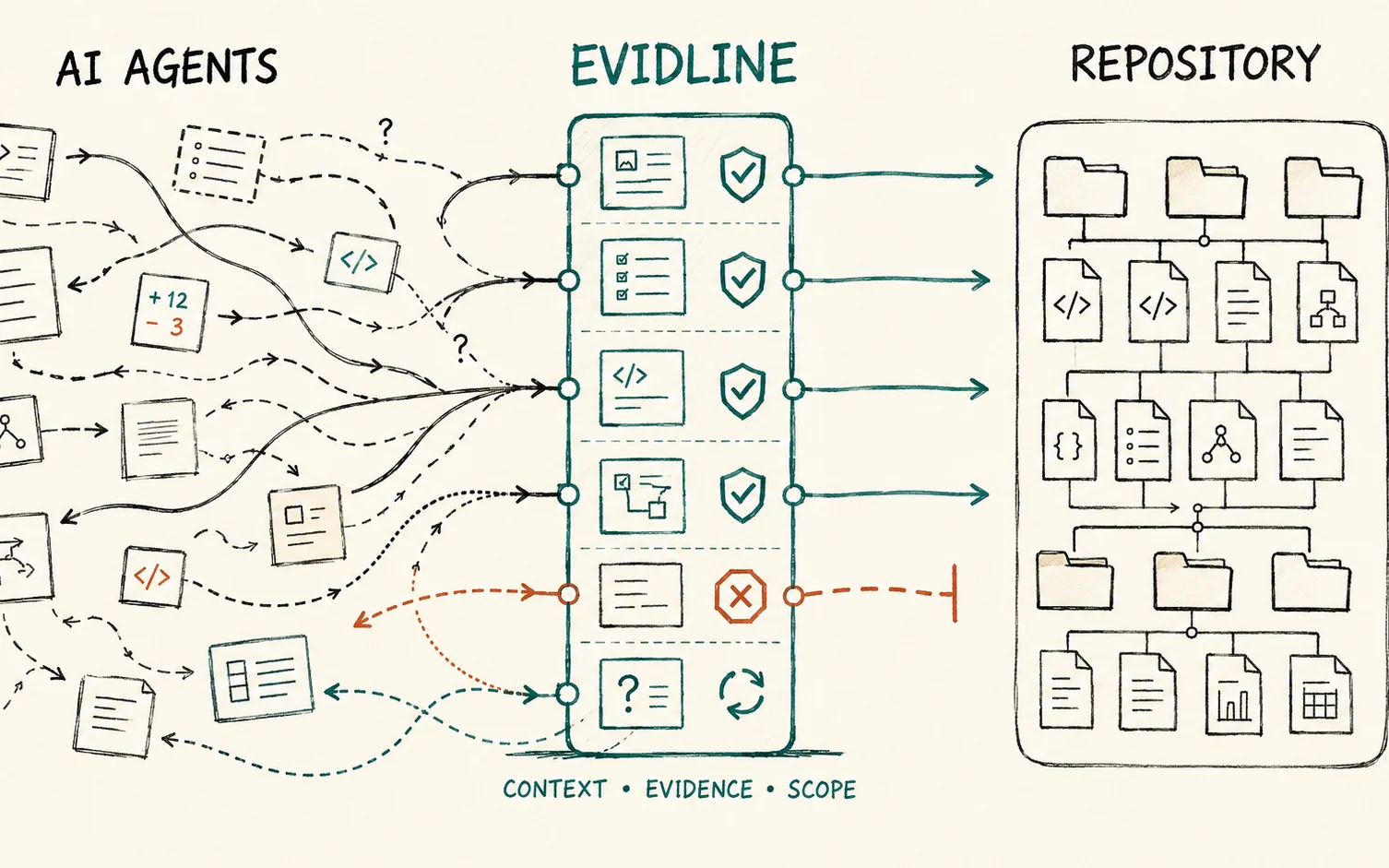
Evidline concept diagram: AI agents pass through Evidline's context, evidence and scope checks into the repository

Evidline

Source

A local-first tool for AI coding agents, aimed at project context, evidence, scope, freshness, invariants, and human-controlled authorization. Foundation components are implemented in the repository. It is still under development, has no published release, and there is nothing to demo yet.

foundationimplemented releasenone yet

Tenzy in a white outfit, taking a mirror photograph in an elevator

I'd rather build it than read about it.

About

I started closer to AI automation, wiring tools together and seeing what held up. That pulled me toward the harder questions underneath: how an agent gets its context, who owns the state it reads, how much authority it should have, and how you would even know it worked.

Now most of my time goes into coding agents, evaluation, and running models on my own machine. I learn in public, and I would rather show one thing that runs than five that only demo.

  1. 01AI automation
  2. 02Agents
  3. 03LLM systems
  4. 04Local AI & post-training
  5. 05Now

How
I work

Principles

Not a methodology. Just the rules I keep coming back to when a system starts getting away from me.

Evidence first.

A claim about a project traces to something you can open, run, or read.

Human approval.

A person stays in control of anything consequential. The agent proposes, the human decides.

Real experiments.

Build the thing and watch it fail. A demo that only works once is not a result.

Verify, then say done.

Rendered, clicked, and checked before it gets called finished. Not inferred from the source.

Understandable systems.

If I cannot explain how it works at three in the morning, it is too clever to keep.

AI
experiments

Lab

Small hands-on builds I use to test what a new model can actually produce, past the benchmark score. Each one ends as a page you can open, inspect and use.

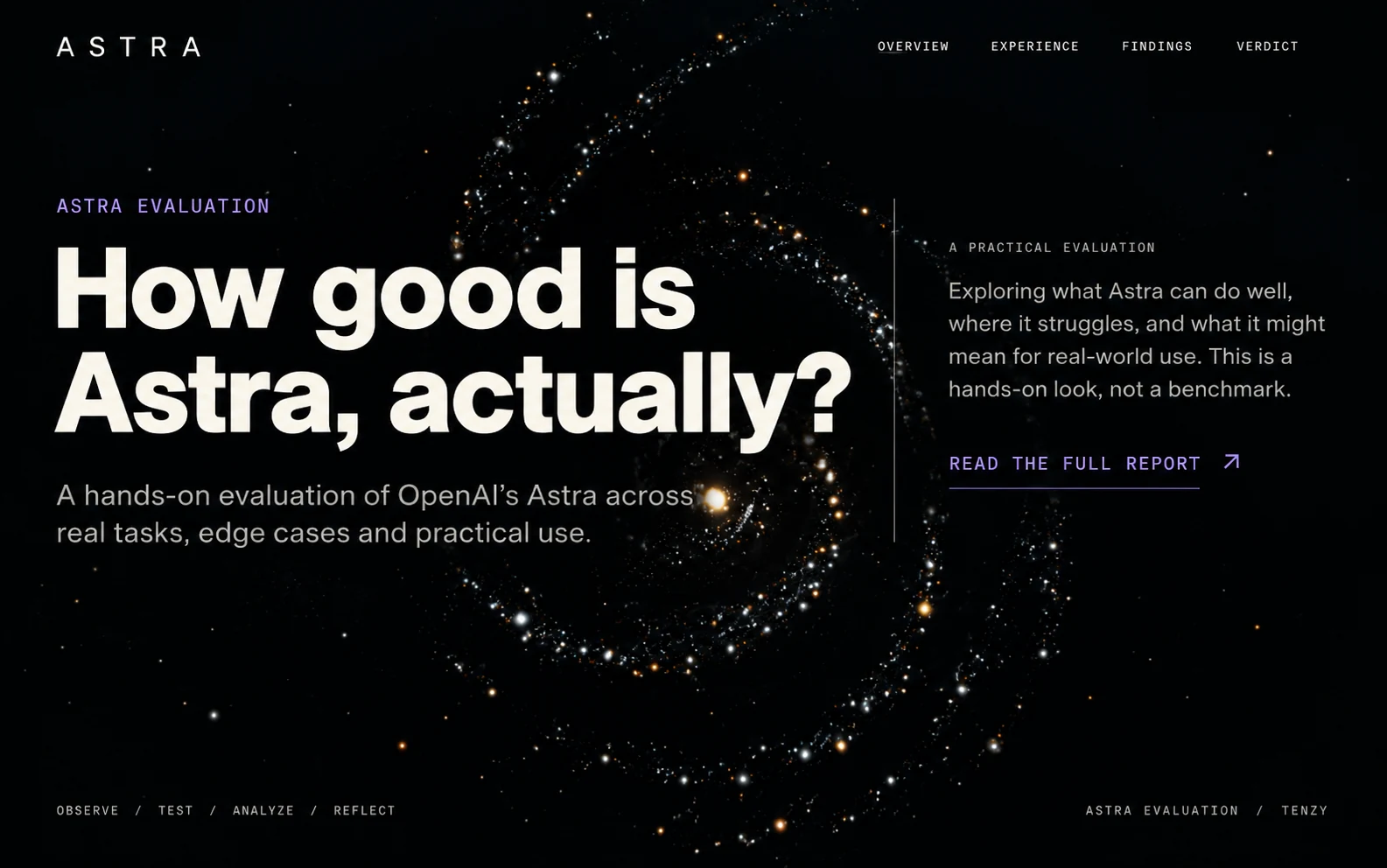
Preview artwork for the Astra Evaluation webpage: the headline How good is Astra, actually? over a spiral galaxy

Click image to preview webpage

GPT-6 Astra Live

Astra Evaluation

Evaluation Research Astra

A research-driven webpage documenting my hands-on evaluation of Astra across capability, reliability and practical use.

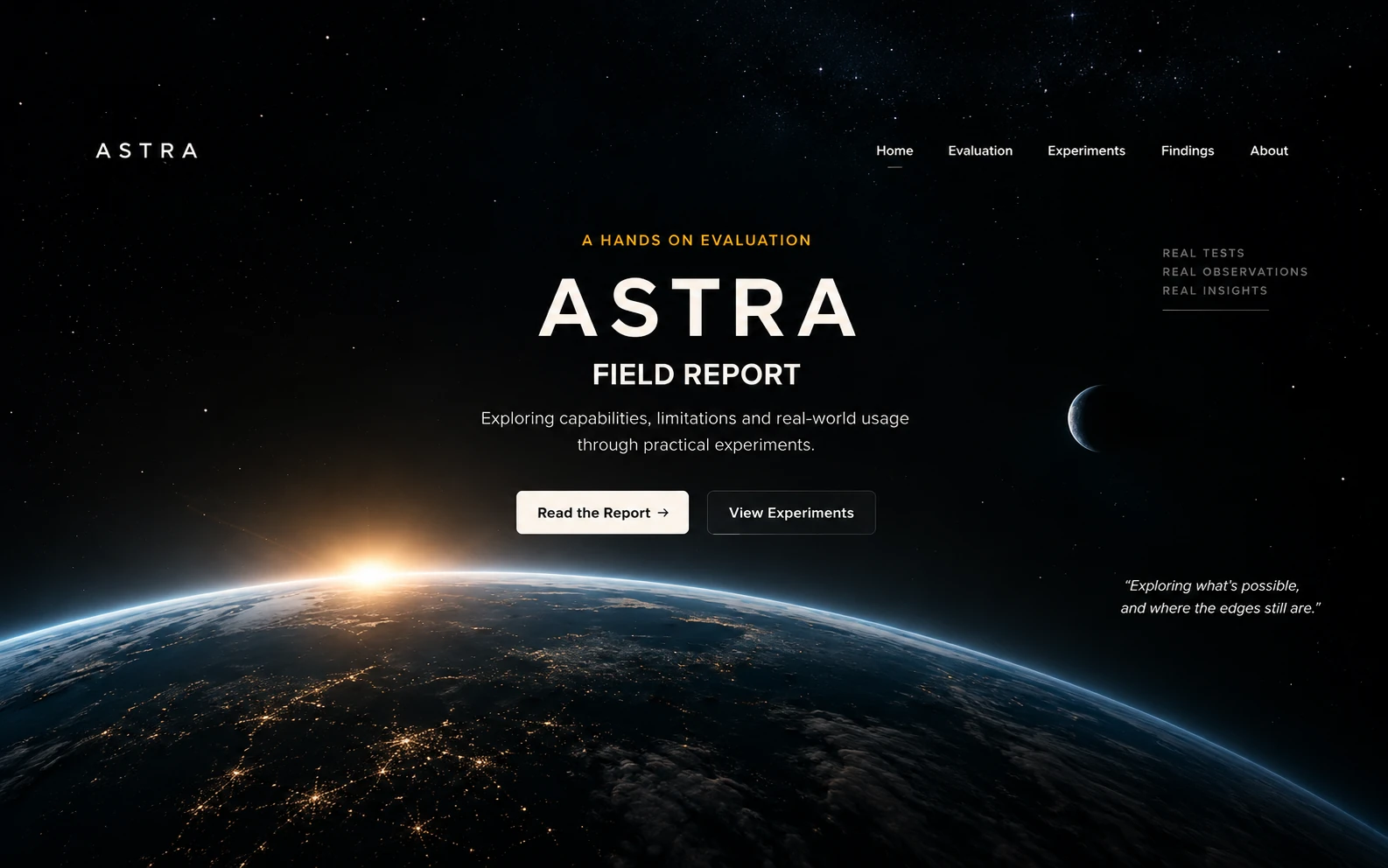
Preview artwork for the Astra Solar System experiment: the Astra title over Earth lit by the rising sun

Click image to preview webpage

GPT-6 Astra Live

Interactive Solar System

Interactive 3D Astra

An interactive solar system used to test whether Astra could produce a detailed visual web experience from a constrained prompt.

Building
in public

YouTube

I record what I am building — the parts that work and the parts that do not.

YOUTUBE / @heytenzy

Questions

Coding agents and evaluation, mostly. The WebMCP Course Planner is the one project that is live; Evidline is the one I am still building.

Running models locally on my own hardware, and post-training: how a model gets shaped after pretraining, and how that shows up in the behaviour you end up designing around.

On GitHub. Both projects above link straight to their repositories, all under github.com/TenzyZ

Yes, especially on agent harnesses, evaluation, and anything where a person needs to stay in control of the loop. Email is the fastest way to reach me.

It lets a web page expose tools that an AI agent can call, so the agent and the person work against the same live application state instead of the agent guessing from a screenshot. The course planner is my working example of that.

Say hello

Let's build something that actually works.